I Ran a 700-Video-a-Month Agency and Was Losing Money: 9 Mistakes (and How to Fix Them in 2026)
Ten editors, clients in two countries, 700 videos a month - and negative margins. The nine operational mistakes that did it, from paying editors by the hour to thinking the business would run itself, with the fix for each in 2026.


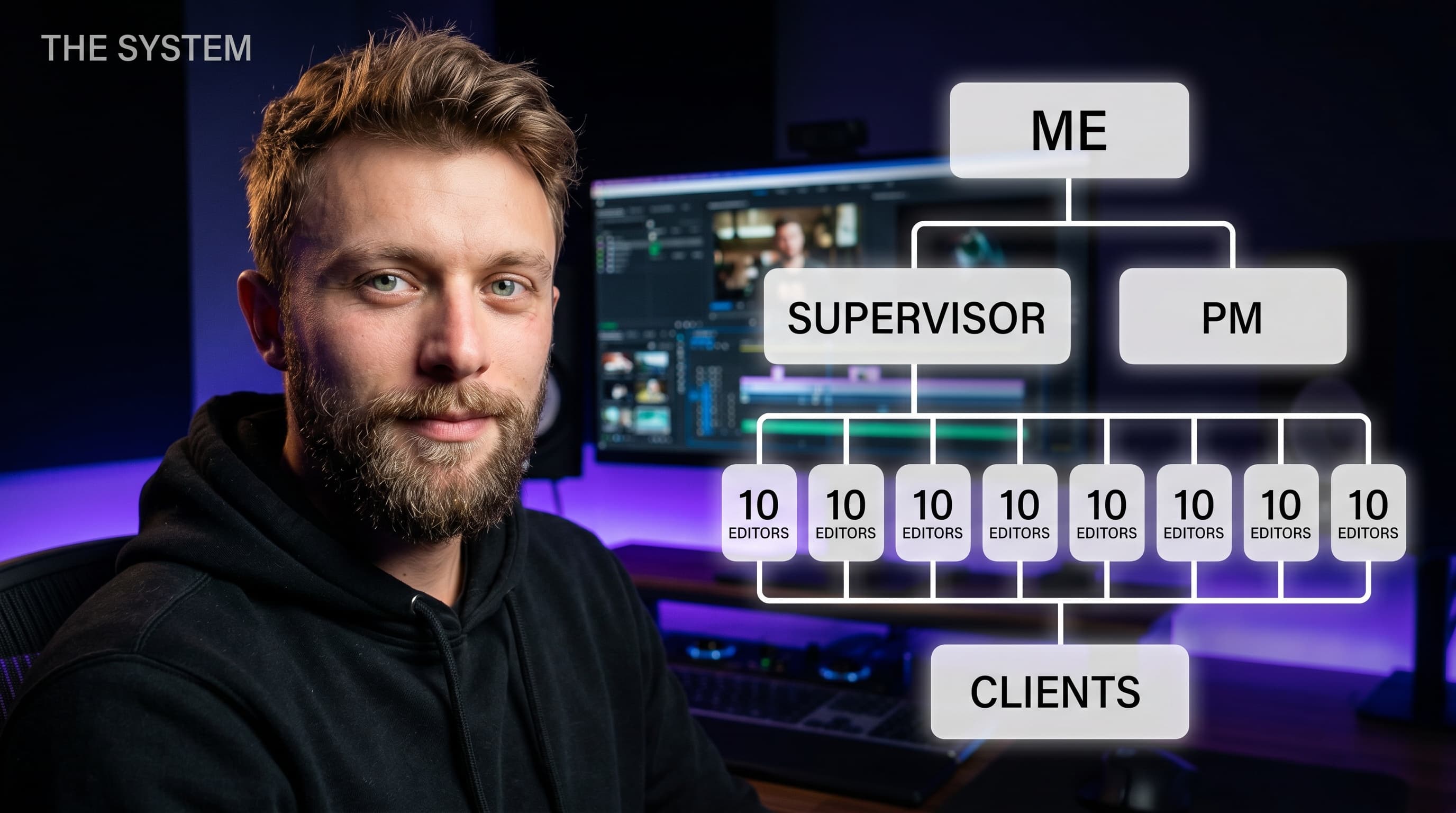
At our peak, my agency pushed out 700 videos a month. Ten remote video editors. Clients in two countries. Work for Suzuki and other big brands. I even flew to the Amazon rainforest to film an indigenous tribe for a competition - and placed third.
Sounds like a success story. It wasn't. I was losing money every single month.
Here's what most advice on scaling a video agency gets completely wrong: the real problem isn't finding clients, it isn't pricing, and it isn't hiring better editors. It's a set of quiet operational mistakes nobody talks about - partly because most agency advice online was filmed in 2022, and the industry has changed since then. Below are the nine mistakes I made building that agency, and how I'd fix each one in 2026, now that AI has rewritten the rules. I walk through all of it in the video too:
1. I paid my editors by the hour
When I started hiring, I paid editors by the hour. It felt fair and safe. It was the dumbest pricing decision I ever made - because paying by the hour means the slower someone works, the more they earn. You are literally paying people to take longer.
One editor told me a video took 14 hours. I paid him. Months later I gave the same video to a different editor - 4 hours, same quality. Same work, three times the cost. It was never about dishonesty; it was bad incentive design. Pay by the hour and you reward time, not results.
The fix is to pay per deliverable. Every video has a fixed price - a short-form reel is one number, a long-form YouTube edit another, a podcast clip another. The editor knows exactly what they earn, and the faster and cleaner they work - fewer revision rounds to fix mistakes - the more they make per hour. Now you're rewarding speed and quality instead of stalling. This single change made my margins healthy for the first time. (More on per-deliverable structures in how to pay video editors.)
2. I was the bottleneck for everything
With three editors, reviewing every video myself was fine. At ten, everything broke. First I let editors send cuts straight to clients to save time - and got burned: wrong logo and colors on one, a typo in the caption on another, a third that misread the brief entirely and delivered the wrong video. My reputation took a hit almost every week.
So I started reviewing everything before it went out, and my life fell apart. Fourteen-hour days. Couldn't go to dinner without my phone. Here was the actual loop: a video lands in Frame.io, the editor pings me on WhatsApp, I open my laptop, watch it, write comments, copy the frame link into ClickUp so the task updates, switch back to WhatsApp to say I left notes, then dig through five Google Drive folders to find last week's file - while three other clients message me in three other chats. Four apps, one video, the same comments repeated three times.
I thought promoting my best editor to supervisor would fix it. But I gave him no training, no checklist, no system - just "you review now." He was reviewing in the same broken setup, jumping between Frame.io, ClickUp, WhatsApp, and Drive. I hadn't deleted the bottleneck; I'd moved it. He burned out in two months.
The real fix wasn't a person - it was a system: one place where editors, supervisors, and clients see everything, where review happens on the video instead of in a chat, and where the supervisor has a clear checklist before anything ships. That kind of internal review workflow simply didn't exist when I needed it.
3. I hired for skill, not reliability
Every interview, I looked at the portfolio. Great cuts, clean color, nice sound design - hired. Week three, they'd ghost, miss a deadline, or argue about revisions. The lesson cost me a lot: a mediocre editor who answers on time is worth more than a genius who disappears.
In 2026 that's even truer, because AI editing tools have raised the floor - a decent editor with AI now produces what used to take an advanced one, so raw skill is cheaper than ever. Reliability, communication, showing up: that's the rare part, and that's what I pay for. Today I give every candidate a small 48-hour test - one deliverable. Not "show me your best work," but "can you hit a small deadline with clear communication?" If yes, everything else is teachable.
Everything I just described - editor tracking, killing the bottleneck, clear briefs, real client portals - is exactly what I later built into Timeliner: project management, video review, client portals, fast storage, and editor KPIs in one tab. Hundreds of video teams have since moved over from Frame.io, ClickUp, and Notion. Back to the story.
4. I ignored the client experience
For years I thought this business was about the edit. But retainer clients kept leaving after three months. When I asked why, they'd say, "You're great, we just need something different." That's client code for "your experience is painful." I was making them log into Google Drive to download, send feedback over WhatsApp, then wait two days for a reply from another time zone. Great edits, miserable process.
Clients don't renew because of the edit - a good edit is the baseline now that AI has made decent editing cheap. They renew because of the experience. So today, when I send a client something, they get one clean link, watch on their phone, and leave a voice note or timecoded comments. No logins, no Google Drive folder full of "final final V3 REAL," just a simple branded review portal.
5. I didn't track editor performance
At peak I had ten editors and no idea who was actually profitable. Some took four revision rounds per video; some were two days late every time. I tried - I even ran a bonus where the top editor that year won a flight to Italy, and she earned it. But I was rewarding by vibe, not data.
When I finally tracked real numbers - revision rounds, on-time delivery, turnaround per video - two of my "top" editors turned out to be the slowest, and one I'd almost fired was my most profitable. In 2026 there's no excuse for flying blind; the numbers should be automatic, not a spreadsheet you rebuild at month-end. That's the whole point of editor and project analytics.
6. I ran my business on WhatsApp and spreadsheets
Project management in Monday.com. Review in Frame.io. Files in Google Drive. Client chat on WhatsApp. Internal chat on Discord. Payments in a spreadsheet I updated at 2am on the last day of every month. Six tools, none of them talking to each other. Every video had feedback in three places, every request got lost in a chat, and every month-end payment calc was a fight between my sheet and what editors claimed.
The clients hated it too - they didn't want a Frame.io account or a Monday login, they wanted to send a voice note and be done. And no, "just use Notion" isn't the answer: Notion is great for docs, but video needs frame-accurate comments, version history, streaming, and approvals that a text document can't do. The real lesson is simpler than any tool recommendation: your team can only move as fast as your worst-connected app.
7. I paid $5,000 to an automations guy
At some point I decided to duct-tape my tools together and hired someone for n8n and Zapier work. Five grand later I had a Frankenstein: Airtable talking to Frame.io, Frame.io pushing comments into Notion, Notion pinging WhatsApp through some API. When it worked, it felt like magic - for about a week. Then a webhook would break, or an API would change, and the fixes came with their own invoices: $300 here, $500 there.
The part that really hurt was the sunk-cost trap. I'd already paid $5,000, so I kept paying to keep it alive, and compromised on features to avoid another bill. And my clients never even used it - they stayed on WhatsApp. The lesson: if the tool you need exists, buy it; if it doesn't exist yet, wait six months, because someone is building it. Duct-taping tools together feels smart until the tape peels off in front of a client.
8. I said yes to every style, every client, every request
Early on I wanted to please everyone. One client wanted Gary Vee-style videos, the next wanted MrBeast-style YouTube edits, the next wanted cinematic wedding cuts. I said yes to all of it - and was effectively running a different agency for every client. Every new style meant retraining editors, retraining my supervisor, and writing new brand guidelines and references. By the time the team got good at a style, the client left. We were always green, never masters.
So I made a hard call and filtered clients down to short-form video only, in just two tiers: Basic (simple cuts, captions, standard color) and Pro (b-roll, motion graphics, sound design, dynamic pacing). One type of content, one workflow. Editors got fast, my supervisor knew exactly what to check, turnaround dropped, and margins went up - and I could finally price cleanly by style and length.
The same trap hides in scope creep: "you do great videos - can you also do our website? our Instagram graphics? a podcast cover?" It feels like an easy upsell; it's a trap. I spent a stretch doing video, web design, and graphics for the same clients - made more money, watched quality drop across everything, and lost clients because nothing was great anymore. Focus is a superpower. Saying no is how you stay great at one thing.
9. I thought the business would run itself
This is the one that broke me. I was single, my life was in a backpack, and I told myself I had systems and a supervisor, so I left for South America for three months. Going from solo to ten editors didn't make things easier - it multiplied the chaos, because now ten people were making small mistakes I wasn't there to catch.
During that trip I lost a huge client over 500 videos: a payment dispute where they said they owed less and I said more, and neither of us could prove it because nobody was tracking properly. I lost thousands of dollars, the client, and trust with my team. That was the breaking point. I flew home, sat at my kitchen table, and wrote down every tool, every problem, every cost - and realized nothing on the market put project management, video review, client portals, editor KPIs, and payments in one place, built specifically for video agencies. So I built it. That became Timeliner.
The throughline
Notice how few of these are about editing. They're about incentives, feedback, visibility, focus, and money - the operational connective tissue that either holds an agency together or quietly pulls it apart. Fix the systems and the talent you already have starts compounding instead of leaking. If even three of these sound familiar, that's where to start - see plans and pricing.